
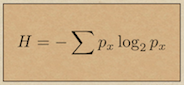
What Really is Information?
This page was created in October 2026.Here is my latest understanding of information (as of October 2026). It is an advance over earlier content of the IFB website, only in that it more clearly and in more detail explains how information is physically embodied and some of the implications that follow. It is not a rejection of what I have written before, just a slightly more sophisticated view of it. My aim is to explain the basic principles of physically embodied information and the way it forms the basis for communications and meaning.
What follows is an accessible description of my conclusions and how I derive them.
When I was a youth, we would look for information in the library where it was (and still is) stored in books; but these days, the World Wide Web is a more likely source, where it is stored in computer memory. Of course, we could always ask someone who knows (stored in their memory) or find out ourselves from perceiving the world around us, in which case the information would be stored in our own brains and we wound know it.
The statement above describes information about things. It is not really a description of information itself and because we are so used to thinking of information in this way (what it is about rather than what it really is), the idea of information itself seems rather mysterious.
This has led some scientists to think that it doesn't really exist at all, but that leaves a big gap in explanations of almost everything. Others complain that including information produces a sort of dualism where we have the 'real world' and some sort of ethereal thing draped over it that we term 'information'. That's a legitimate criticism of many descriptions, especially in biology, but it contributes nothing to explanation. My contention is that information is very much a part of the physical 'real world' (a monist, as opposed to dualist claim) and I further claim that information is no more mysterious than the way physical things are arranged in physical space and time. We already have the idea that information is the constraint of randomness - the result of this constraint being something particular, rather than anything at random (see Entropy).

Take a random assembly of items and organise them into a particular pattern - you have constrained their arrangement, reducing entropy and creating information.
Physically Embodied
The idea that information is the pattern of arrangement of 'things' in spacetime (to include the temporal dimension) is a shift away from information being about anything. Instead, it regards information as just another aspect of physical reality, devoid of meaning. But instead of the immaterial concept of binary bits and analogue variables found in classical (Shannon) information theory, it is a real physical entity.
That is because a pattern among physical things is necessarily physically embodied. It is embodied by the things whose arrangement forms the pattern. We can confirm this, by noticing that every case of information in the first paragraph, is one of a physical object 'storing' it (by embodying it). Computer memories, books, human memories and magnetic tapes all store information in a physical medium. So do DNA molecules and the particular forms of structures, from the Forth Bridge to the anatomy of a lung. My contention is that there is no information that does not depend on a physical medium to contain it. If you are sceptical about that, try to think of a kind of information that is not physically embodied (noting that I count human memories as somehow embodied by the human nervous system).
The kind of information I am describing, I call physical information Ip, for reasons that are hopefully obvious. It is always embodied in a physical medium, but we know it is not always confined to any particular one. When someone speaks to you, information is transferred from them, into sound waves and then into you (if you are listening). Information in the computer memory can be transferred onto the screen and into you if you read it. So in a sense, while the information is physically bound, it is also portable; being able to move from one embodiment to another. In technical language, we may say it is multiply realisable, or that it transcends its medium of embodiment. Of course that is because a particular pattern (arrangement of things) can equally well be in one medium or another: information is not changed by its medium.
In fact, every object in the world is what it is because its material (medium) is informed by its embodied information that gives it form.

Formal Information
Sometimes it is useful to think of information without reference to the medium, or any physical aspect of the system it is in. Examples include the mathematical analysis of interactions among streams of information (e.g. data on information channels), based on Shannon's information theory, or that of algorithmic information processing in engineering design and theory (e.g. cellular automata). In these cases it is purely mathematics and its underlying logic that counts for us, so we abstract the idea of information away from its physically embodied reality and into a conceptual domain where only the rules of logic apply. This notion of disembodied information exits only in the formal world of logic, so I call it formal information If.
It is tacitly assumed (and very rarely mentioned) that If is the sort of information being thought about when engineers and physicists work with information theory (in the Shannon sense) and in designing computer programs. In a strict sense, If is not really information, rather it is an abstract representation of information in a conceptual system of logic. Indeed it is the misconception that If is information, that leads to its appearing as some mysterious metaphysical entity 'draped over matter'. Before using the convenient abstraction, we should remind ourselves that If is only a representation of information, not the real thing.

It is in the formal logical mathematical world of If that we encounter Shannon's theory and also cybernetic control theory and computation science (in total what most people think of as information science). Much of Shannon's communications theory involves statistical relationships among data. A good example of statistical information is the mutual information between two data sets - it is a generalisation of correlation, measuring how much information each data set holds about the other. It is not information, instead it is just a metric of information properties. I refer to all these metrics as examples of statistical information Is.
So far: physical information Ip is a pattern embodied in a physical medium and formal information If is a hypothetical abstraction of that from its embodiment. Shannon's information theory is a statistical account of relationships among If (e.g. Mutual Information) that collectively I term statistical information Is.
Means of embodiment
When we describe real information (Ip), we have to take account of the way it is embodied as a pattern in a physical medium (including the energy of forcefields). Especially, we have to consider the physical limitations imposed on its embodiment and the way it can move from one kind of embodiment to another. That calls for a more precise description of embodiment: I refer to it as the domain in which information is embodied. One thing is already obvious: we have to specify the physical medium. That is the stuff that physically embodies information through its non-random distribution in space and time. It is either material that can be distributed unevenly (e.g. the ink on a page), or a forcefield, usually an electrical one, in which variations of field strength and direction form a non-random pattern. The reason I keep referring to non-random here is that information is also definitively the converse of randomness (here we do follow Shannon).
Guaranteeing it's not random
Now, it is all very well saying information is a pattern in the medium,
but how do we (or anything else) discriminate between a random
distribution and a particular pattern that is information? There are two
things to say about that. The first is probability and the second is
motifs.
The only way a configuration of objects can be non-random is if there is some coherence among them, which implies there must be some spatiotemporal correlation that last longer than the characteristic timescale of thermal noise (i.e. the parts hold approximately their relative positions longer than would be expected at random). It may seem like common sense that information is only possible if particles are coordinated for long enough to have an effect, but it draws attention to important underlying physics. Unless everything is at absolute zero temperature, matter and its associated forcefields are constantly jiggling and jostling about (thermal noise). In gasses and liquids, this movement means that the configuration of constituent particles is constantly changing, so any particular pattern lasts only for an extremely brief moment. Unless some additional force has the effect of coordinating the movements of particles into some coherent arrangement (all moving together), they will remain randomly arranged. There are two cases. First, if an exogenous coordinating forcefield is present, the particles can carry a longer lasting pattern under its influence. This is what happens in e.g. a sound wave, where molecules in a local region of space move in unison for a time longer than would be expected from random thermal noise. Second, intrinsic inter-atomic forces may locally hold a group of atoms or molecules in a coherent pattern - even indefinitely - which is why molecules exist at all, but also why they form the many nano-structures found in living cells, such as ribosomes, microtubules and the actin-myosin filaments that are the foundation of muscle cells. In general (beyond life), solids form because the inter-atomic forces are strong enough to constrain thermal movements, limiting their constituent particles to vibrating on the spot. You will notice that both coordination effects making information possible act locally - that is because physical forces loose strength with distance.
Patterns are not just static. Sound travels through solids too (as anyone hearing the neighbours through the wall can testify) - molecular vibrations are added to by a locally coordinated back and forth as a pressure wave is passed among them. A few kinds of metal solids have electron pairs (dipoles) in their atomic structure that create a magnetic field and the alignment of these can be coordinated to make permanent magnets. More interesting here is that they can be locally arranged to form a pattern that matches one imposed by an exogenous patterned forcefield (e.g. one generated by an electromagnet). This is the basis for tape recording and computer hard drives. Otherwise, any configuration in a solid, e.g. of shape, or in the distribution of materials, are rather fixed at the time of its formation. Often the colour of an object is determined by 'impurities' in composition: the dyes in linoleum tiles and in fabrics are a good examples. When ink and paint dry, they leave a thin solid coating behind and this is how patterns such as printed pages are made.
Perhaps a little less familiar is the idea that the shape of a solid object (e.g. a spanner) is itself an embodiment of Ip. If a shape is not random, it is informed (literally formed by investing the material of which it is made, with information). When a stone is carved with letters or symbols, it is invested with information embodied by its new shape. One useful way to think about that is to ask how much information would be needed to accurately describe the shape of the stone - the more writing, the more information. When solids naturally form through cooling, they may 'freeze in' thermal randomness at the molecular scale. The alternative is some kind of pattern, either in the overall shape of an object, as in the spanner cast from molten steel, or in its composition, e.g. the variation in microstructure of steel in a Japanese sword, or the distribution of colour within an ornamental glass paperweight.
Configurations of molecules -
motifs
We have started thinking about information deliberately placed in
materials by, presumably human agents. Let us return to the natural
where we are looking for a natural coherence among the otherwise random
movements within a fluid. The only physical way that can occur is by the
physical forces extending from atoms making some particular
configurations of them more likely and perhaps even stable (locked in)
if they are strong enough. The obvious example is the way molecules form
with atoms in specific positions relative to one another (though they do
vibrate and some can move among a small number of options). In proteins,
the resulting molecular shape is often biologically functional (e.g. as
an enzyme) and changes in shape are often definite and reversible, so an
ideal opportunity for information processing. Proteins also can
self-assemble into structures, sometimes including molecules like
lengths of RNA (as in the ribosome), or small molecules, to form
functional molecular machines, such as transmembrane pumps, engines (the
ATP synthase complex) and the chemo-electromechanical motors of muscle
cells. These all form because the shape of their components fit together
in a 'relaxing' (free energy minimising) configuration. Ip is
embodied in the shapes of the molecules and also in the way they fit
together in these nano-machines. Of course atoms and molecules also form
regular patterns, often spanning what would be enormous distances from
their scale-perspective: we see these as crystals. Their potentially
endless extent is due to repetition of a motif, where here the motif is
a configuration of a small group of atoms or molecules. Under the same
circumstances, this small group adopts the same relative positions
(their configuration is a stable motif) which in particular ways, (with
specific symmetry) self-matches, creating a regular pattern of motifs.
It is like the repeated motif in a wallpaper pattern and one thing we
can glean from that is the Ip is essentially all embodied in
the motif which, by its own shape, is repeated over a symmetric grid.
Crystals, then are essentially locally determined at the scale of the
motif and through simple repetition create larger scale structures that
add little further information. Now we can make a little conceptual
leap. The crystal as a whole embodies Ip, and most of it is
in the motif that is repeated over a geometric grid, usually in three
dimensions. For convenience, we will ignore the physical embodiment for
a moment and see the motifs as symbols in a hypothetical If
(remember If is always the hypothetical abstraction of Ip).
If we represent the motif with the symbol T then the crystal is a three
dimensional version of TTTTTT... .
Suddenly we have a system for recording any binary information in a string of motifs: TTFTFFT... and remember this is entirely natural and not designed by human ingenuity. The inclusion of F and T in a crystal, creates what Schrodinger called DNA ("an aperiodic crystal") - before the structure of DNA had been discovered! Of course DNA has four motifs - the four nucleotide bases enabling it to carry information in the pattern formed among them. For another example, under the microscope, a computer memory or processor chip is seen to be a thin crystal of silicon into which a pattern of other minerals has been etched (doped with impurities) to make the 'hardwear' of silicon-based computing. That pattern is not the information contained in the memory, it is the empty vessel for carrying it. The term in semiotics is sign vehicle - information is embodied by the sign vehicle through particularising the empty slots provided by its 'hardware' structure. In the case of silicon-based memory, the particularisation is of electrical charges held across microscopic gaps in the structure created by the pattern of etched impurities. In the case of DNA it is the particular 'flavour' of nucleotide (choose from adenine, cytosine, guanine, or thymine (A, C, G, or T)) that fills a nucleotide position in the chain of the nucleic acid oligomer. Notice that in both cases (and in general) the information carrier is itself a structure of embodied information; it can carry arbitrary (any desired) information by particularising its structure only because it already has a structure to particularise. This sign-vehicle structure is an organised pattern of motifs and the motifs are the fundamental unit for the basis in information embodiment.
A good example, to take stock at this point, is the naval signalling system using flags.

Naval signalling flags: each flag is a motif and carries its own
meaning in the flag code. Image credit:
From https://dockyardtalk.com/blog-posts/tag/Trafalgar
photo shows masts of the real HMS Victory in its permanent dock in
Plymouth.
Probably the most famous naval signal was the one flown from the British flagship HMS Victory in 1805 by Admiral Lord Nelson at the beginning of the Battle of Trafalgar, reenacted in commemoration every year (see link on image credit). The signal (information) is embodied by a set of signal flags (the motifs) that are hung on a signal line (halyard) and the physical system of halyard and flags (a full set of motifs kept in a signal locker) constitutes the Ip of the sign vehicle. Individual flags form the basis of the flag signal code and a particular message formed from a chosen set of flags, once placed in the right order and hauled up, is the signal carried by the sign vehicle. In the same way, DNA is a sign vehicle for genetic information in which the nucleotide bases serve as signal flags (motifs).
Local and large scale pattern
Put slightly differently, DNA is an example of (relatively) large scale pattern built from selecting a particular sequence of a members of a set of local patterns that we have called motifs. These patterns are naturally occurring and result from localised electric forcefield interactions among atoms. For relatively simple signals (as in most cellular signalling pathways, e.g. from hormone to metabolism) the individual motif is sufficient to, by itself, embody the whole message of information. That is reminiscent of Howard Pattee's famous "How does a molecule become a messsage?" paper of 1969. Pattee said he wanted to know: how to distinguish communication between molecules from the normal physical interactions or forces between molecules which we believe account for all their motions. One of his first insights into this was that communications of messages involves a simplification of all the details (about the sign vehicle) to produce just the logical connection between the molecule (more generally the motif) and the result of it being there - what we might interpret as its 'meaning'*. To put it simply, in communication (as opposed to just physical interaction), the motifs are seen as single items - their innards are not recognised and communications uses only the pattern among motifs. That means communications operates at a higher level of organisation than the underlying atoms, molecules and forcefield that hold motifs together and join them in readable chains or arrays.
* Let us just note for now that all meaningful information is
made that way and meaningful information is only ever associated with
life - we can park that idea for later scrutiny.
Information embodied at a higher organisational level obviously implies the creation of a nested hierarchy of levels of organisation - something we see a great deal in the structure of organisms. It also implies coherence of pattern over larger spatiotemporal scales. But because physical forcefields quickly decline in strength with distance from their source, long range coherence is so unlikely it is statistically implausible. Even local coherence - the short range correlation or fixing of spatiotemporal relationship that gives us motifs -produces a striking contrast with statistical equilibrium (where randomness prevails). The only plausible way to achieve long range pattern is through organising the spatiotemporal arrangement of motifs, thereby creating a higher level of organisation. As we saw, this can happen spontaneously in crystal formation, but since for them, the higher level of organisation is very simple repetition, the additional information embodiment at the higher level is negligible. To have significant Ip at the higher organisational level, it seems something must be working to create and maintain it. Therefore, the existence of higher level patterns (e.g. DNA) that are neither as simple as crystal lattices, nor random provides us with an indicator of communication, along with its connotations of function, meaning and intention: attributes associated (only) with life.
A
summary of embodied information concepts.
So far we have established that physical information is embodied
as spatiotemporal pattern in the assembly of particles of matter, or the
field strength of forces, and that such patterns are characterised by
the medium in which they are formed, the basis (e.g.
motifs) of the pattern and the scale at which it occurs.
We also have the idea that higher level patterns can be made from lower
level patterns (e.g. as strings of motifs) where then, Ip is
composed of that embodied by the motifs and also that embodied at the
higher level of their spatiotemporal organisation.
Since this higher level Ip can, in principle, be formed in
multiple ways (e.g. with different sorts of motif, in different media,
etc.), it is reasonable to consider it in abstract as If and
physically possible that it can be transferred from one form of
embodiment (one domain of medium, basis and scale) to another.
That transfer, we shall see, always requires a specific structure
embodying additional Ip to enable it: the transducer.
Once we see transducers and higher organisational level information
embodiment, we are right to suspect more than merely thermodynamic
inevitability. We are ready to consider communications.
The concepts explained on this page prepare us to understand how life
uses Ip in communications and, as Pattee and Deacon put it
"how a molecule becomes a [sign or] message".
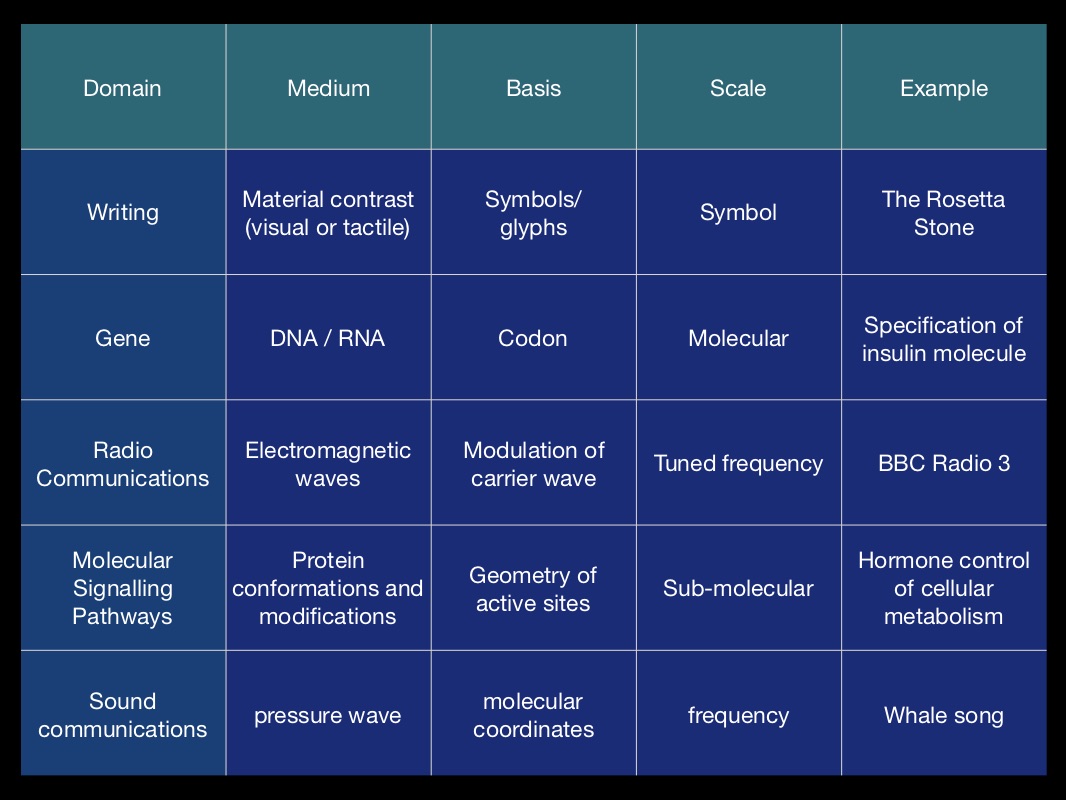
Now, we can look at the table below which shows examples of different
kinds of information embodiment. For each, I name the domain and specify
its medium, basis and scale, giving an example. It would be nice if you
can think of an example yourself and specify its medium, basis and
scale. You might also notice that every one of the examples in the table
are ones of information intended for communications.
Significantly, they are also all found in living systems, or the
artefacts they (well, we) make. Radios and computers, etc. are really
tools that humans developed and all tools are intentional extensions of
the body (and mind). As such, they are entirely dependent upon
biological systems (for their existence); they do have function, but
their function is defined in terms of the biological system that
designed, created and maintained them. The alternative to information
embodied for communications is information embodied simply as the form
of an object, our canonical example being the spanner. For that, form
gives function and the intended function is a set of constraints on the
form (in the formal information domain of design). Non-designed, natural
objects also have form (e.g. snowflakes) which embodies Ip,
without intentional function, though function may be assigned to them by
an intentional system, for example a paleolithic human assigning
function to a stone to be used as a hammer. Though many animals do this
sort of thing too (e.g. crows and octopus use tools), we will never find
a river using a stone or any example of non-intentional systems
assigning function. Currently the only intentional systems we know of
are living systems - there is now the possibility of human tools being
intentional (AI), but that is a matter for another webpage.
References and bibliography
Pattee, H. 1969. How does a molecule become a messsage? Development Biology Supplement 3. 1-16. doi: 10.1007/978-94-007-5161-3_3
Deacon, T.W. 2021 How molecules became signs. Biosemiotics 14. 537-559. doi: 10.1007/s12304-021-09453-9
A good explanation of ways in which Shannon's theory of commmunications is used in biology is:
Adami C. 2016 What is information? Phil. Trans. R. Soc. A 374: 20150230. http://dx.doi.org/10.1098/rsta.2015.0230
Work by Keith Farnsworth developing the ideas expressed on this page can be found in:
Farnsworth, K.D. 2022. How an information perspective helps overcome the challenge of biology to physics. BioSystems. 217. 104683. doi:10.1016/j.biosystems.2022.104683.
Farnsworth, K.D. 2023. How biological codes break causal chains to enable autonomy for organisms. BioSystems. 232. 105013. doi:10.1016/j.biosystems.2023.105013.
Farnsworth, K.D. 2025. How Physical Information Underlies Causation and the Emergence of Systems at all Biological Levels. Acta Biotheoretica. 73. 2. 6. doi: 10.1007/s10441-025-09495-3.
An introduction to transducers can be found in my blogpost here.